

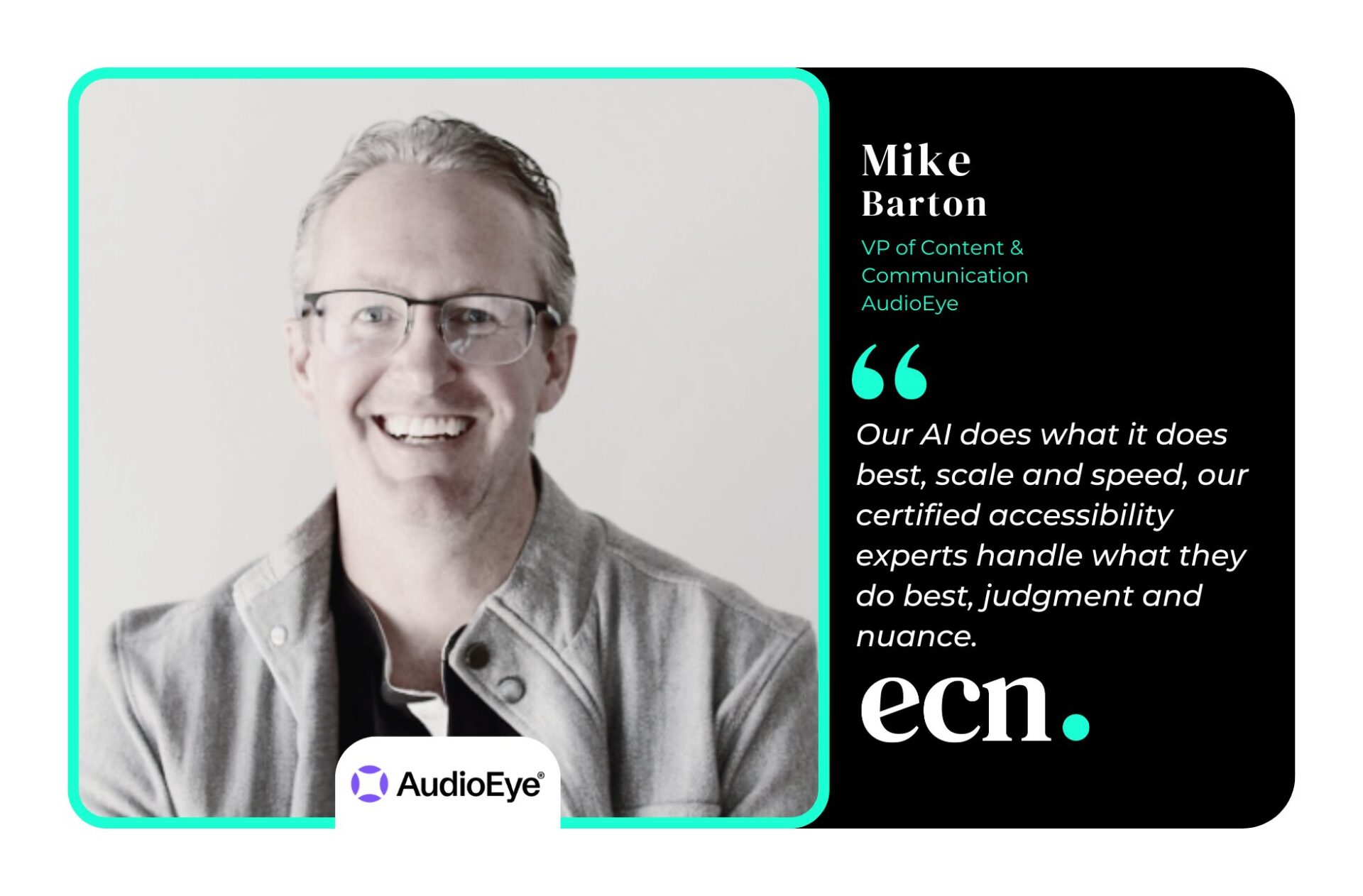
1. To begin, could you introduce yourself and tell us more about AudioEye’s mission and vision?
“I’m Mike Barton, VP at AudioEye, where I lead our content marketing and communications teams. AudioEye is a digital accessibility platform built on a simple idea: every person should be able to use the web. For over a decade, we’ve combined AI automation with human expertise to find and fix accessibility issues on the sites and apps people use every day. Today, more than 127,000 organizations trust us to keep their digital experiences open to everyone, including the 1.3 billion people globally who live with a disability.
Our mission is to deliver the strongest, most cost-effective accessibility protection in the industry. Our vision is bigger: a digital world where accessibility isn’t an afterthought or a legal scramble, but the default. That’s the bar we hold ourselves to, and it’s why we keep investing in better detection, faster fixes, and stronger legal protection for our customers.”
2. AudioEye has been working on digital accessibility for nearly two decades. How has the company evolved since its founding?
“Digital accessibility was a niche concern when AudioEye started. Most companies treated it as a checkbox or ignored it entirely. What’s changed is that the stakes have caught up to the principle. Lawsuits have doubled in the last five years. New laws like the European Accessibility Act now reach across borders. AI is fundamentally changing how websites are built and how users find them. And more and more companies recognize the business benefits of making their websites accessible.
Through all of it, we’ve doubled down on one belief: automation is how you scale accessibility, and human expertise is how you get it right. We’ve continued investing heavily in our AI, because that’s how we cover thousands of pages and detect issues at the speed the modern web demands. But we’ve never bought into the idea that AI alone is enough. The most complex accessibility issues still require human judgment, context, and lived experience. So as we’ve leaned further into AI, we’ve leaned just as hard into the experts who validate it. That balance is what scales, and it’s what holds up”.
3. For those unfamiliar with the topic, how would you define digital accessibility and why is it becoming a critical issue for businesses today?
“Digital accessibility is the practice of designing websites, apps, and digital content so people with disabilities can use them with the same ease as everyone else. That includes the 1.3 billion people globally who live with a disability, many of whom rely on assistive technology like screen readers to navigate the internet.
For businesses, this isn’t a side issue anymore. It’s a revenue, legal, and brand issue at the same time. People with disabilities represent $18 trillion in global spending power. Seven out of ten will leave a site if it doesn’t work for them. Most people with disabilities will only shop where they know they can. On the legal side, U.S. accessibility lawsuits have doubled since 2020, and the European Accessibility Act now applies to any business serving EU customers. The companies treating accessibility as a checkbox are the ones getting caught off guard. The companies treating it as table stakes – or a growth engine — are winning.”
4. Can you explain what AudioEye’s platform actually does and how it works in practice?
“In plain terms, our platform finds accessibility issues on your website and fixes them before your customers ever notice. Our JavaScript loads with your site, the same way a cookie banner does. Our AI then scans the rendered page against the WCAG standard, detecting up to 2.5 times more issues than competing tools, based on a 2026 independent study by Adience. Around half get fixed automatically, in real time.
But automation only takes you so far. The barriers that put real users and real revenue at risk often live in the gray areas: context, intent, and how a site actually feels to someone navigating with a screen reader. That’s where our expert audits come in. Certified specialists, including people with disabilities, dig into what AI can’t see, then write and deploy custom fixes directly through the platform.
The result: roughly 97 percent of issues resolved before your team gets involved. Software finds the patterns. Experts find what hides between them. Together, they make accessibility actually work.”
5. One of your key differentiators is your hybrid approach combining automation and human expertise. Why is this combination essential?
“Because accessibility isn’t a problem you can solve with technology alone, and it isn’t one you can solve with humans at scale. Automation handles the volume. AI can detect and fix things like missing alt text, broken form labels, and heading structure issues across thousands of pages in real time. But around half of accessibility issues require context. They depend on what a button is supposed to do, what a screen reader user is trying to accomplish, what a complex carousel is meant to convey. Those decisions require expertise. So our AI does what it does best, scale and speed, and our certified accessibility experts handle what they do best, judgment and nuance. That combination is why our legal protection rates are three to four times higher than other solutions.”
6. What types of companies or industries benefit the most from AudioEye’s solution?
“Honestly, any company with a digital presence. If you have a website, you have an accessibility obligation, and you have customers who deserve to use it. We’re trusted by over 127,000 organizations across e-commerce, healthcare, financial services, travel, government, and more. What makes that possible is a model built to scale from the smallest local shop to the largest global enterprise, with the same level of protection at every tier.
That said, certain industries feel the urgency faster than others. E-commerce is the clearest example, since 78 percent of accessibility lawsuits now target online retailers. Healthcare, financial services, and government also carry heightened legal and regulatory exposure. But the underlying truth is the same regardless of size or sector: every business has customers it can’t afford to leave out, lawsuits it can’t afford to lose, and developer hours it shouldn’t be spending on work that automation and experts can handle.”
7. Accessibility is often linked to compliance and legal risk. How does AudioEye help businesses meet regulations?
“We help businesses meet regulations by making compliance the byproduct of doing the work right, not the goal of a one-time audit. Our platform detects more accessibility issues automatically than any other solution, getting our customers that much closer to accessibility right out of the box. From there, our certified auditors review what AI can’t catch, and any remaining issues get resolved through custom code fixes deployed in the platform or clear guidance for fix at source. The result is coverage across every WCAG A and AA success criterion, and ongoing monitoring against the ADA in the U.S., the EAA in Europe, and the regulations driving most accessibility lawsuits today.
When a demand letter or claim does arrive, our team validates the allegation, produces an expert debunk report, and works directly with your legal counsel. We’re the only vendor with a documented courtroom dismissal, and the only one offering a real legal guarantee, not a warranty with terms that are nearly impossible to collect on. Bottom line: we deliver 300 percent more legal protection than fix-at-source consulting and 400 percent more than automation-only widgets.”
8. Beyond compliance, what are the business benefits of investing in accessibility, especially for e-commerce brands?
“This is the part most e-commerce leaders underestimate. Accessibility is a conversion lever. People with disabilities represent $18 trillion in global spending power, and 83 percent of them limit their shopping to sites they already know work for them. If your site doesn’t work, they don’t bounce and come back later. They go to a competitor and stay there. Removing accessibility barriers means higher conversion, lower bounce rates, and reach into a customer base your competitors are actively excluding.
There’s a newer angle too: AI agents are starting to navigate the web on behalf of users, and they read your site’s accessibility tree to do it. If your site isn’t accessible, you’re invisible to one of the fastest-growing discovery channels online.”
9. How does your solution integrate into existing tech stacks and workflows for digital teams?
“Implementation is usually the easiest part. Our platform deploys through a single line of JavaScript, the same way a cookie banner or live chat widget does, so most teams are up and running quickly. We work across CMSes, custom builds, headless setups, and partner platforms like Duda.
From there, our AI takes over: 24/7 monitoring of real user sessions, automated fixes deployed in real time, and custom fixes written by our experts and pushed through the platform without your developers having to merge a single pull request. For the small set of issues that need source-level work (typically under 5 percent), we deliver detailed source feedback reports so your engineers know exactly what to change. Everything is tracked in one dashboard: what we found, what we fixed, what’s outstanding.”
10. Finally, what are your ambitions for AudioEye in the coming years, and how do you see the future of digital accessibility evolving globally?
“Two things I’m watching closely. First, regulation is going global. The European Accessibility Act came into force in 2025, and more jurisdictions will follow. Companies that have only thought about ADA risk in the U.S. are about to discover their compliance map just got a lot bigger. We see that as an opportunity to help more businesses, in more places, get this right.
Second, AI is reshaping the web from both directions. As AI gets better, our automation gets better, detecting more issues, fixing more in real time, and learning from every site we touch. But there’s a flip side. General-purpose AI coding tools are generating a more inaccessible internet, faster than ever, because they’re trained on a web that was already inaccessible. Solving that gap is one of the most important problems in our industry, and it’s one we’re built for. At the same time, AI is becoming the new front door for discovery. Agents are reading accessibility trees to find products, content, and answers on behalf of users. Accessibility and AI discovery are going to be the same conversation in a few years, and we want to be the ones leading it. The internet should work for everyone who uses it. Our job is to make sure it does.”
